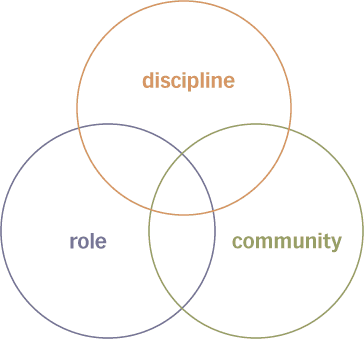
When I first came across the information architecture community and had my big ah-ha moment identifying what I practiced, envisioned and aspired for as 'information architecture', I finally felt as though I had found my true calling. This community of practice helped me validate my choices and more than anything, allowed me to find a path to pursue a career in information architecture - a clearly nascent as a discipline at the time.
Looking at what I have accomplished so far and the choices I have made to get to where I am today, the one frustration has been advocating and educating people about what I practice, envision and aspire for AS 'information architecture'. The attacks from our colleagues in 'sibbling disciplines' or our own dissatisfied 'dissidents', make it hard for the discipline to be perceived as such because the 'voice' of information architecture is dilluted.
But that only makes it difficult. It doesn't make it true. Whether people use design, usability, business consultancy or another handle to express what they do, it doesn't exclude the fact that they effectively practice information architecture (to different extents). The label of choice (design, business, consultancy, usability, engineering, user experience, ___2.0, etc) is a sales mechanism; it's a way to tweak the message of what you offer to fit the audience you serve.
As much as this dillutes the prominence of information architecture, it doesn't hurt it's core as a discipline. It gives me great joy to see the Information Architecture Insitute growth because it's a symbol of the strenght of the discipline. However, it saddens me that people have not embraced IA as a shorthand for something of value that they can sell, and so IA is perceived by some (including those who benefit from the practice, such as clients) as moribund. To that point, the community need to continue to create more mechanisms to validate and exercise the practice so that this process can be facilitated.
Personally, I have not let go of the title of information architect because it works as a strategic tool to continuously sell information architecture and its value - whether its because people are intrigued about what it means, or because they want to clarify if I know how to do other things (all those other shorthands) in addition to their understanding of what information architecture is, or some other reason. What has been more important than the title, however, is not letting go of information architecture as a discipline, as a tool to sell services, as a mechanism to show results and produce value.
So long as we persist on trying to expand IA boundaries as opposed to attempt to encapsulate it into something else, or attempt to constrain/cement the existing boundaries, information architecture will continue to grow and thrive as it has been. IA has grown and is growing because of the practitioners who are not interested in finding a comfortable place to be, but looking for ways to continue to change. Role, community and discipline are integral to making this happen.
In other words Peter, I could not agree more. Thank you for framing it so well.
Woohoo! This is terrific. Thanks for still self-identifying as an information architect. I do too and it's nice to be in good company!
And one more little piece in the IA community is Oz-IA, which we held in Sep and will hopefully continue...
Livia, thanks for your support and enthusiasm!
Donna, I apologize for the omission and have added Oz-IA to the list.
Andrew, I also feel a bit "trepidatious" about IA for physical spaces. But selling the ideas of transmedia wayfinding and cross-channel IA doesn't mean we have to do all the work ourselves.
For instance, I've had good discussions with the folks at...
...and would love to find a way to work together on a project that bridges physical and digital environments.
Somebody has to cross the bridge. Perhaps it's time we became a bit more intrepid :-)
On my bookshelf I have a number of books that I dig into for inspiration and guidance. These include Information Architecture (V1.0), The Inmates are Running the Asylum, Information Anxiety2, Making the Web Work, The Essentials of User Interface Design and Designing Business to name a few. I have a series of links that I surf to see what the buzz is that reflects the domains of my bookshelf.
I've held many titles, User Experience Designer, Information Architect, User Interface Designer and Communication Designer.
In a nutshell, these are all different aspects of the same thing. Designing an artifact to suit a set of goals and tasks. Generally the size of project dictates how specialized my role is. If I'm the only person on a project, I'll play everything, if I'm on a team of specialists I'll play one role, and support other roles. I really don’t care what my title is.
I actually came from a formal Architecture background. My education centered around understanding and applying design principals as they responded to social, technical and physical factors. My education was pivotal in shaping my perspectives on design as it related to the human condition. We needed to understand the user, their tasks, the functionally use of space and then design around those elements. We had to play with concepts of space, proximity, scale, materials and form. I believe the maturity of real world Architectural principals eclipses that of Information Architecture. Sure there are parallels, but this is a different discipline that requires a different mindset (I'm sure I'll take a few hits for this). I think there's a lot of synergy between the two, but if you want to design buildings, then get yourself a degree in Architecture (it’s a long road!).
My two cents.
PS Looking forward to picking up the third edition!
I enjoyed this article, but honestly wasn't comlpetely convinced. I agree that IA describes a well-defined discipline including taxonomy, ontology, structure, and findability. And I'm sure that there are some folks out there who do these tasks 90% of the time (or more) who can accurately call themselves IAs.
But I find that most of my peers frequently step beyond the practice of IA into other well-defined disciplines to achieve the goal of crafting a user experience. And even though my business card has included the words "information architect" for almost 10 years, and likely will continue to do so for expediency's sake, I think of myself as an experience architect(XA), and identify myself to peers as such.
I prefer the term XA to experience designer simlpy because I'm not especially well grounded in aesthetic (usually visual) design. Rather I try to create structures, processes, vocabularies, and interactions that enable great experience design from someone with better "finish" skills. And while IA is often a big part of that picture, so are many other disciplines, from cognitive and behavioral psychology to composition theory to usability engineering to copy editing.
I guess my point is that I prefer to self-identify according to the types of projects I do rather than the myriad of methods I employ...at least when it comes to speaking with people who understand IA or are willing to spend a few minutes learning.
As for my business cards...well, as long as the check clears, they can call me anything they want.
Hi Peter,
What a great a post. With it, you've done an excellent job of re-framing the conversation of late.
Also, thanks for referencing one of my recent posts as part of the conversation going on here.
Let's hope you don't have anytime to post here next year! ;)
Scott
Before I read this post, I had written one over on the AP blog very similar themes.
http://www.adaptivepath.com/blog/2006/11/29/greatly-exaggerated/
I also find it funny that you label me as one who feels constrained by definitions, but then you cite the words I wrote in the IA Institute business plan about the domains of IA. I'm doing what I can to encourage IA to grow so that it continues to be relevant to my evolving concerns; I encourage other IAs to do the same!
Yes Peter. I discovered your post this morning, and commented (still pending moderation) that I mostly agree.
In a couple of recent talks, at IDEA and in Chile, you have argued, with the Polar Bear book as your prop, that we made a mistake in the 1990s by defining IA too narrowly.
I disagree. To start a new discipline, it's important to begin with a narrow definition that's focused on core competencies and unique value. That's the point Jesse made so eloquently in ia/recon.
Now that we have succeeded, and IA is well-established, the time is right to be more expansive.
So, we disagree about the past, but appear to be on the same page about the future. Cheers!
Didn't read PeterMe's article till just now and I have to say I don't disagree too much with it. As for your post Peter Mo, I liked it a lot, but did have some issues. It was a rather long response, so I posted it on my blog here:
http://synapticburn.com/comments.php?id=201_0_1_0_C
I do think there is a big contribution in the article and that is the mention of community as a piece of the organizational puzzle. That was great!
Dave,
Thanks for your thoughtful, balanced response. We don't agree on everything, but the discussion is productive. Cheers!
Finally IA is moving to intersect Industrial Engineering and common path human-machines.
RSS means common language for people and computers. Human role become more creative.
For example RFID tags are all applications of IA Business Plan. More than this, strategies become more adaptive, more responsive.
First, discussion open more feelings than points of view!
Peter, yours is a very eloquent statement regarding IA, what it constitutes, and what its ambitions should be.
I've been mulling a comprehensive response to the recent conversation -- or is it a debate? -- for publication on Total Experience. The fact that it's not yet posted testifies to the complexity of the issues.
I remember a 2004 gathering at Stanford keynoted by Don Norman that brought together 10 representatives of various design disciplines: IDSA, STC, UXD, IAI (I believe), and others in a grand conversation. (Notably, physical architects, landscape architects -- whom I believe hold many secrets regarding organic, ambient design -- themed-attraction designers, and design engineers were absent.) The idea was to find common touchpoints among the disciplines. Sadly, the night ended on a note of dischord rather than design collaboration.
IAs have had it pretty good of late. As some of its critics have pointed out (with not a little envy), the Web economy has provided many opportunities to ply the IA trade. But for it all, among other communities of designers -- at least those with whom I speak -- IA still translates to "Web design." In the meantime, another, related strain of design -- information design, which predates IA as you define it -- is seeing a resurgence and even incorporation in the plans of, for example, exhibition, themed attraction, and environmental/urban designers. (Wurman's attractive book on information designers, provocatively titled, *Information Architects* -- I argued him on that point prior to publication -- and my own *Information Design* make that case.)
Focusing on one's profession and becoming both expert and well-reputed, as you recommend, is always wise. Having had an eclectic career myself -- communications researcher, legislative policy analyst, interface R&D lab director, company CEO, ecommerce consultant -- I'm experienced in how difficult a sale a generalist design approach can be to prospective clients and HR managers. Still, IAs can do a much better job of reaching across the disciplinary boundaries, if not actually stepping across the thresholds. The IAI business plan is a nice statement of intentions, but seriously, it requires an acceptance by non-IAs that is going to be challenging to obtain without effort.
I personally admire Hilary Cottam's ambitions, taking RED out of the UK Design Council, to practice "transformative design." This overarching purpose entitles her, in the minds of clients, to practice whatever stripes of design are essential to reaching the clients' goals. For the same reason, I've been advocating "experience design" in its original meaning, but it's become so diluted as everyone tries to get on the bandwagon -- "user experience design" being a prime culprit -- that it's become an upstream swim (to everyone's disadvantage, I believe).
It's cool that O'Reilly is bringing out Polar Bear 3.0, because it remains the best treatment of IA as you define it. The fact that it's O'Reilly, however, a publisher that defines itself by its computing origins, means that it will be classified among books dealing with digital phenomena per se, and not necessarily their significance in the broader world of human experience.
Attacks on IA to me seem peevish, but IA has you for its champion, so not to worry. The real challenge for IA is how to practice in the larger world of which the Web is one integrated though extensive part. This will call for levels of outreach and interdisciplinary collaboration not seen before (and not just from IAs).
Bob,
Thanks for expanding this discussion in time and scope. And I apologize for any inadvertent dilutive harm caused by my "user experience design" article.
And, for folks (like myself) who have managed to remain ignorant of the work of Hilary Cottam, here are a couple of starting points:
http://www.designmuseum.org/design/hilary-cottam
Peter
You're welcome, Peter. No apologies necessary for "user experience design": whoever coined the term was correct in noting that using the Web is an experience. But it's only one among many. Even in terms of the Web, if the person doing the experiencing is simultaneously dealing with a radio in the background, alarm at global warming, a project due the next day, and a crying baby, already the IA has more to think about than navigation among textual and video objects. Drop the "user" and you get back to the general case, intergrative, interdisciplinary design to provide multidimensional solutions for human problems of understanding.
Peter,
Congrats on a great article! However, I feel as though I need to respond to your quote from About Face 2.0.
First, I would like to make clear that this comment does not reflect my or Alan's current thinking about IA. Your article, by juxtaposing Moggridge's new book with AF2.0, makes the implication that this is a new "attack". In fact, it was written in mid 2002, at the bottom of the dotcom bust, when most IA's that Alan and I knew were out of work, and when IA/web design firms and fortunes were still in a state of severe recession. So, we were calling it as we saw it at the time, with-- as you might expect-- a bit of a partisan bias.
What we didn't see then was that the big brick and mortar companies would start snapping up IA resources for pennies on the dollar, and by this means IA would get deep penetration into corporate America, or that many thought leaders would take their time out to broaden and deepen the discipline with the many great IA texts that were published around 2003-2004 (many of which are on my bookshelf). So, we were certainly very wrong in our assessment of IA's future fortunes.
Our concerns with the "web-centric" focus of IA is perhaps better expressed as content-centric focus. This is clearly a necessary focus for any system delivering content, but in the context of what AF2 is trying to define and discuss-- the design of product and service behaviors--it is just part of the whole puzzle.
I hope your inclusion of such a dated passage (one of several now rather dated passages in the Introduction to AF2) doesn't mean you only just got around to looking at IxD texts like AF2! I really think that IA and IxD (and ID for that matter) stand to gain far more from collaboration, cross-pollination, and collegiality than from territorial battles, but find that the lenses through which each discipline views the work at hand can be quite a hurdle. This is one reason why I believe so strongly in personas as a means to get designers of all stripes outside of their own biases and focused upon the real needs of real people.
About Face 3, to be published early next year, will not contain the quoted passage. Last year, I served on the advisory board of IAI, and feel like I have a very warm relationship with the IA community and its leaders. I hope the community will forgive a bit of past shortsightedness on my and Alan's part.
Robert.
Robert,
Thanks very much for your response which does clarify your perspective then and now.
I must confess that I did purchase and open AF2 recently along with several other interaction design books. I'm a little slow, but at least I'm headed in the right direction :-)
It's great that you've provided advice and leadership in both IAI and IxDA communities. We need more bridge building. Cheers!
"Information Architecture Under Attack" ?! Give me a break!
I may be the dissenter in the crowd, but I resent feeling constrained to Information Architect to describe my title and my role. It made more sense to me 5 years ago than it does now.
"...the current campaign, led by senior practitioners of our sister discipline - interaction design - is worth mention..."
This doesn't have anything to do with potentially compromising the sales of the polar bear if claims made by these "senior practitioners" gain ground, does it?
I think this is a limited look at an expanding field which has changed tremendously over the past decade. A name is just that - a name. It can, and in my opinion, should change if the community deems it so.
Why this should threaten anyone is beyond me.
The opportunity I see is in the area where enterprise and information architectures meet.
> "celebration of the total absence of information
> architects from Designing Interactions"
As the author of that "celebration" I guess I should say that I wasn't actually "celebrating" the absence of IAs in Moggridge's book as much as I was *fascinated* by the fact that the interaction design world is as balkanized as any other professional practice, with different subcultures and milieus often completely unaware of each other.
Note that Moggridge's snub of the IA world goes in the opposite direction, too -- most of the personalities, products, and companies in his book are practically never discussed in the IA scene, either. Of the 40+ names on the cover, only 8 are familiar to me, and none of them because of my participation in the IA scene.
I think of social networking as a metaphor for this balkanization: I have many parallel circles of friends: my family friends, my college friends, my workplace friends, my IA scene friends, my design scene friends, my art world friends, my AI-programming friends, my party friends, my personal blogosphere friends, my political blogosphere friends. I can have hard core discussions about interaction design in more than one of these "spheres", by the way.
If IA continues to be only one of many professional milieus in which the subject of interaction is investigated, is that a bad thing?
Thanks for clarifying your celebration Chris. And no, I don't think that's a bad thing, as long as there is a reasonable amount of investigation going on. If everyone did as much cross-training as you, we'd be in good shape. Cheers!
As I was reading through this rather astonishing thread, three things occurred to me:
1. I must be getting old.
2. Some here might not be aware of the Unidentical Twins story.
3. Some seem to still be unaware of the strategic space race that is underway all around us.
This is a difficult story to tell in this format and one that is unlikely to appear on any of the Information Architecture driven blogs. It is shared with you here with the intention that it might help some of our friends in the present Information Architecture and Strategic Design communities who are attempting to make sense of what they are seeing in their own community and in the broader marketplace. It is a story that not everyone will likely appreciate.
Some of you might know that Elizabeth Pastor and I had the privilege to work with Nancye Green, Richard Wurman and others in what are now considered the early days of the Information Architecture movement. Nancye and Richard were both pioneers in Experience Design, Information Architecture and Information Environments Design. We learned a lot from them both. Elizabeth and I found ourselves outside of what became the Information Architecture community when its purpose was narrowed and distorted early on in the dot-com era. For us (and likely others from the early days), there is a great deal of irony in this thread. (More on this later.)
As surprising as it might be that Peter Merholz and I agree on anything, I do think his recent acknowledgment regarding the narrowing of dot-com-era Information Architecture is quite correct.
The remaining text (too long to post here) can be found on the NextD site:
See: IA’s Unidentical Twins (Revisited)
An Information Architecture Transformation Story
http://nextd.org/index.html
Other Links that might be useful:
Design 3.0 / Making Sense of Design Now! / Sept 2005
http://nextd.org/media/qt/NextD_Design3_0.mov
AskNextD 1 / November 2005
http://nextd.org/pdf_download/AskNextD1.pdf
ReReThinking Design Model / November 2004
http://nextd.org/media/universe/index.html
Grant Campbell's article about Being Shallow is on topic and worth reading:
Information Architecture Institute
The IA Professional Association.
Information Architecture Summit
The Annual IA Conference.
Information Architecture 3.0
The IA Summit Workshop.
Polar Bear, Third Edition
Louis Rosenfeld and Peter Morville.
Blueprints for the Web
Christina Wodtke.
Information Architecture for Designers
Peter Van Dijck.
Practical Information Architecture
Eric Reiss.
Information Architecture Wiki
Eric Scheid.
Information Architecture Library
A Collection of IA Resources.
IxDA
The Interaction Design Association.
UXNet
The User Experience Network.
InfoDesign
Peter Bogaards.
A List Apart
For People Who Make Websites.
ASIS&T Bulletin
Includes an IA Column.
Boxes & Arrows
Design Behind the Design.
Rie Yamaoka
Designer Behind Three Circles (3.0).
Digital Web
Web Professional's Online Magazine.
GUUUI
The Interaction Designer's Coffee Break.
OK/Cancel
Kevin Cheng and Tom Chi.
UX Matters
The User Experience Magazine.
Belarusian Translation
Patricia Clausnitzer.
Ubiquitous Service Design
Article by Peter Morville.
Semantic Studios
109 Catherine Street
Ann Arbor, MI 48104 USA
734.347.2826 voice
734.661.5265 fax
Awesome post! I wonder what it'll take to find that common 'feel' for what we all mean when we say IA and that it has a future? I agree with needing a focus. I said it better here...
http://www.inkblurt.com/archives/343
...so I'll just quote: "We need to come to some shared understanding on what Context of Need we *primarily* address...We don’t do ourselves any favors by trying to define ourselves with contexts of need that other practices and disciplines already cover quite nicely on their own (even if they don’t always do it well). Just because another Context of Need can be helped by some excellent taxonomy and card sorting work, it doesn’t necessarily mean IA is the best Practice for the job."
Which is why I'm trepidatious about designing physical environments. If it's to help integrate ubiquitous digital info spaces into the physical experience... awesome. But wouldn't an architectural wayfinding expert be a better choice if you're talking layout and signage? (Of course, if one isn't on hand, I'll be happy to retro-fit my IA expertise as best I can!)