Excellent... now, are we going to see a book based around the honeycomb diagram? Well, at the very least I am going to be excited to hear what you have to say in your WebVisions keynote. See you there!
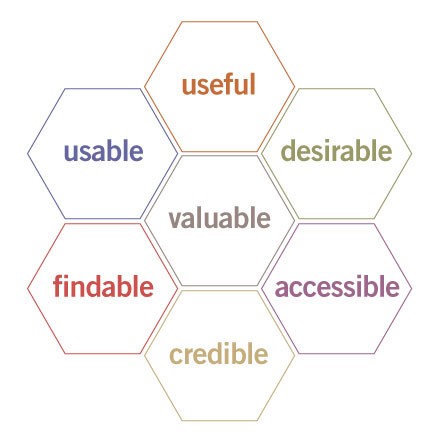
I'm impressed. Simple, clear, sizable chunks. Seven elements that are easy to remember.
I can see how the honeycomb is useful for starting discussions about a site. However, I find the honeycomb diagram a fairly arbitrarily assembled tool. The facts of the honycomb are very different in their level of abstraction. For example, 'usefulness' is on a much higher level than 'findability'. Findability can also be seen as an 'aspect' of making a site more 'usable'....just like 'Accessible' contributes to making a site 'Usable' for certain groups of users. Further more, all facets address end-user relevant issues while 'valuable' addresses a 'client-side' issue.....odd
So why are other issues such as 'task-centered-ness' or 'personalizable' not in the diagram? Just to name two examples....
I am not trying to be over-critical here, I simply wonder why these facets make up the honeycomb.....
Great article. Will share all around here. We're currently on a project that echoes many of the facets you describe in the honeycomb. Looking forward to sharing it as I trot around the globe. ML
Excellent. Accessibility also includes access from non-desktop browsers, which have many of the same difficulties as those with disabilities. Text in images are often unreadable on text or small graphical mobile screens. The same goes for Flash.
There is a close relationship between usable and accessible once one steps away from using the Web with more than a desktop based browser.
To Martin's point on 'valuable' being a client or sponsor facet vs. a user's facet - my read on the honeycomb when I first saw it here in Edmonton was that 'valuable' applied to both the business and to individuals - there has to be ROI for the organization, but there also has to be a 'Return on Experience' for the user. Shared value is key for long term sustainability.
The problem with this model is that it make us think that these attributes are orthogonal dimensions. Don Norman is better to explain why it isn't correct:
http://www.ok-cancel.com/archives/post/2003/10/playing_the_tuba.html#000042
Paulo, I had to spend a few minutes with dictionary.com to figure out how you're using "orthogonal." I assume you're using it loosely to mean "mutually independent or well separated." In that case, I guess the diagram is guilty as charged, though you can easily explain the interdependencies in the context of an article or presentation. On the otherhand, maybe I should have stuck with overlapping circles... :-)
Impressive! I like it - it makes perfect sense to me. I can also see why some people don't like the presentation of the idea based on their experience and worldview. If you added arrows then the hierarchy (all the outer cells contribute to the innermost) might make immediate sense to more people. On Martin's comment above - accessibility and findability can mean the same thing, but if they are different "check list" items then it reduces the chances of things being forgotten in the overlap between the two facets. This may be a personal thing - I work best when I can look at a situation from as many different angles as possible.
I like the elements of the honeycomb a lot but not the honeycomb itself. Martijn is right, the relationship between the elements needs to be represented as well.
Stepping aside from the brilliance, I'm attempting to place this into the worldview of 'truths'. I have an issue with the 'label'. It's not specific enough. While I'm the 'anti-user' proponent, the fact that the term is engaged here still requires a 'truth' test.
"User", before the days of technology, was applied to product interaction. There's prescidence here as to 'viability' of the term. If I'm using a new can opener, many of these terms are irrelevant.
But I believe they are relevant to a very specific category of 'use'. The title simply needs to better attribute that specific universe so that it can maintain it's truth.
Hey... I'm diggin this. Dave at the office just pasted it together into a word doc and printed it in color and we stuck it in our cubes. It's fun to have new diagrams.
But I really have to wonder... did Jesse's hexagons have anything to do with inspiration?
http://adaptivepath.com/images/pillars.gif
And.... you guys both need to tell the truth... did you used to play a lot of Avalon Hill war games?!?!?
(there was a time when I saw hexagons in my sleep...)
ok, nerd flashback over. really.
oh, I meant to say... the only reason why I brought up Jesse's hexes was that when I saw that one, I wanted to come up with a diagram using hexagons too, but just didn't think of anything.
Ok... back to work!
Not to pig-pile on this topic, but I also would like to see some flow, direction, and/or representation of the relationship between the elements. The elements seem fine to me.
Andrew, as far as I know, JJG's pillars didn't inspire my use of hexagons, but it's always hard to say where our ideas actually come from. I prefer to think I was inspired by Honeycomb cereal...
http://www.kraftfoods.com/postcereals/cereal_honeycomb.html
...or perhaps it was the Honeycomb Conjecture...
http://mathworld.wolfram.com/HoneycombConjecture.html
...or perhaps it was Honeycomb, the game...
http://clevermedia.com/game.php?honeycomb&1
And Paula, I think the label specificity issue is dealt with adequately through audience self-selection...I seriously doubt many inhabitants of the can-opener design universe read my column :-)
If I read the comments correctly, you (Peter) are saying that the facets of the honeycomb are actually overlapping circles (= not orthogonal). That basically means that the visually pleasing honeycomb is an oversimplification of the facets and their relationships...
Yes Merche, all definitions and diagrams are simplifications (or if you prefer oversimplifications) of reality. As Alfred Korzybski, founder of General Semantics, once said: "the map is not the territory."
First off, great diagram. It brings out some key areas to focus on and should facilitate discussions well.
You said:
--
I was hired to perform my first findability audit for a major international nonprofit. Feeling a bit concerned about dedicating four weeks exclusively to findability, I asked whether I should also consider usability factors. "No thanks," my client replied. "We already had Jakob in last year to focus on usability."
--
While I can appreciate that companies cannot always afford to do full audits across all the areas you mention, I can't see all of these areas being modularized. I know we're talking about overlapping hexagons but some of the hexagons are more tightly woven than others - to the point that I wouldn't conceive of the mbeing modularized.
Let's consider, instead of an audit situation, a new product or launch of a site. Sure, we can focus more on one aspect over another but can we really say "for starters, we'll make it usable with help from Jakob Nielsen and next year, we'll get Semantic Studios in and make things findable"? I know I'm taking an extreme example and nothing is mutually exclusive.
I guess my (long winded) point it simply that the honeycombs not only overlap, some of them overlap a great deal over each other and can't be separated. Which then begs the question: perhaps these are just subsets in the original three circles?
How about adding a new cell, "Searchable: our site must be search engine spider friendly to ensure proper indexing and better search engine ranking." --just a thought.
Peter, thanks for sharing. This is nice work.
I think it'd be interesting to build a user experience organization based on the honeycomb. That is, instead of typical job titles like Interaction Designer or Information Architect, everyone would have their own focus on two or three of cells.
My focus would probably be Useful, Valuable and Usable.
Seems like this approach could also help avoid some of the usual arguments between disciplines, such as usability vs. visual design.
What do you think?
In the UK accessability for websites is the law.
Kevin, I created this diagram precisely because the dominant model in recent years has been to lump everything together, often under the label of usability. There's value in swinging the pendulum back in the other direction, even if there are cases like the audit where it may have made sense to tackle other facets at the same time.
So, you might consider my honeycomb as a strike against the empire of usability. Now, we'll have to wait and see if the empire strikes back. And, if you create a comic about this epic struggle in the spirit of...
http://www.ok-cancel.com/archives/week_2004_02_13.html
...I'd like a cool name like the Faceted Findability Freak :-)
Cheers!
F-Cubed
Brad, modeling a UX team or consulting group around the honeycomb would be very interesting indeed, but I don't think you're allowed to monopolize 3 facets...you have to pick one :-)
The User Experience Honeycomb could be used in conjunction with this diagram that focuses on the various disciplines of user experience:
http://www.interactionary.com/files/disciplines_radial.gif
[developed by Rosenfeld/ McMullin in 2002]
Information Architecture
Knowledge Management
Information Design
Brand Management
Usability
Interaction Design
Customer Relationship Management
Interface Design
Content Management
Also holistic user experience concepts/ interdisciplinary thinking should reach out to:
University /Academia: including Business Schools [especially Marketing]/ Information Systems/ HCI/ Library & Information Sciences, Media & Communications etc
Consultancy Community: including strategy/ management consultants
and practicing business managers and Professional Associations/ and Business conferences:
particularly those involved in Direct Marketing, CRM/ Marketing Analysis, Branding, Advertising, PR, Organizational Learning, Internal Communications, Knowledge Management/ Business Information & Library Management ..and Business/ Systems Analysts - as they are key change agents
Information Architecture /Usability / Interface Design professionals/ communities - should focus more effort to reach out to these other business professional areas to encourage collaboration and mutual understanding.
Imagine what a well researched "user experience" overview article published in a journal such as Harvard Business Review could do to encourage interdisciplinary thinking and create better holistic user experience solutions. [inclusing users within companies on intranets, extranets/ web for business-2-business, or using the web for communication/ commerce etc]
This could action senior business managers to place improving "user experience design" at the top of the business agenda.
Maybe it's just me, but the article immediately made me think of apophenia http://www.skepdic.com/apophenia.html and pareidolia http://www.skepdic.com/pareidol.html - the stimulous is quite vague and the meaning is whatever one brings to it. ;)
It's definitely a clever and great looking diagram. What designer wouldn't want to have user experience summarized in the geometrically perfect form of a honeycomb?!
I'm looking for connections between the user experience honeycomb and Norman's recent focus on expectation driven design.
http://www.google.com/search?hl=en&ie=UTF-8&q=%22expectation+driven+design%22
What aspects of the honeycomb do you believe are part of user expectations? If user's don't expect it, can it be discounted? As Ron Zeno said, the user experience may have more to do with what the user brings to the table than what designers dictate.
Una versión en español de este artículo ha sido publicada en el sitio de AIfIA:
http://aifia.org/es/translations/000370.html
[A Spanish version of this article has been published in the AIfIA site at the above address.]
I've recently been trying to answer two silly little questions: "How can you predict the success of a given design?" and "What is the link between good experience design and the ability to charge a premium price?" I figured a solid afternoon of thought would be enough time to answer those...
In trying to answer both of these questions, I have come up with a variety of not-quite-right diagrams that are similar to the Honeycomb. The "what makes up an experience" diagram, the "key levers to improve design" diagram, the "criteria of good design" diagram, etc.
The problem I have found in all of these, which I think exists too in the Honeycomb is the interdependency issue, but to a greater degree than I think others have commented on here. It's not just that the hexagons should overlap like the three circle diagram, it's that many of these areas affect *many* of the other areas. Credibility and desirability are as tied to each other as desirability and usability. Accessibility is strongly tied to usability and usefulness as well as desirability, etc.
My current thinking is that a given Honeycomb-style diagram is useful as a starting point, but that given any specific context of product type, audience type and business need, the specific cells and links between them must be modified, expanded or removed.
Peter, I enjoyed reading your thoughts. It seems to me that you've overcomplicated things in the honeycomb. The tried and true useful, usable, and desirable ven diagram describes everything quite well (perhaps with Value at the center). The other three are really just subsets.
Thanks Challis. I've heard that "just a subset" argument before. You need to read Ambient Findability [1] which explains that:
Findability precedes usability.
In the alphabet and on the Web.
You can't use what you can't find.
Seriously, there's value in teasing apart more than three (or even six) user experience qualities. The honeycomb is more opening move than end game.
I'd like to thank you for this demonstration, it is really simple, focused, and comprehensive. As an Arabic technical author, it really adds a great support to my writings.
Thank you again
I like the honeycomb very much... At Digital District we developed with our UX-Team and some scientists a new approach to user experience. We call it the TIDE-Model and it includes economic values into the user experience.
While we were thinking about the TIDE-Model, we had a lot of disscussions regarding the honeycomb and I have to say... you are right in many ways...
In about one month we will release the english version of our homepage and you will find the TIDE-Model explained under http://www.digitaldistrict.de/user-experience.900.0.html
Please tell us what you think, when you took a look at it.
I finally got around to starting a blog about user experience and user-centered design and your honeycomb is the first subject. Check it out at http://userexperienceproject.blogspot.com/.
After reading my post it would be interesting to hear if you agree. Is the facets in the honeycomb listed in the wrong order?
It's certainly interesting to consider the order of facets within the context of experience. I'm not sure the linear model holds up in all cases. For instance, I may never try using a product that I don't find credible. And, a linear model doesn't invite consideration of the overlaps and relationships (e.g., the way that findability enhances credibility). But, your version does encourage us to think a little more (and diffferently) about user experience design. Thanks!
Great article!
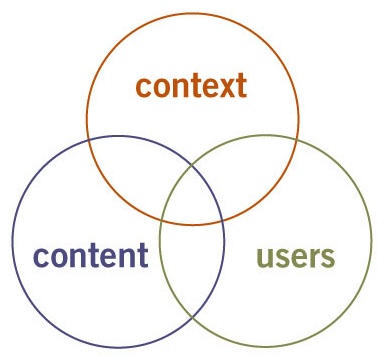
Can anyone please help a newcomer to the subject with how you (as you put it) "illustrate the distinction between user experience and user-centered design" with the circles. Is the context circle missing in UCD. I've never really understood the difference between UX and UCD but would really like to know what I'm not getting...
Emil,
UX and UCD are often used interchangeably, and the differences are subtle and somewhat semantic.
UCD puts the user at the center. UX emphasizes "experience" and allows for a balance between user needs and business goals (the context circle).
That's how I see it. Others are welcome to chime in. Cheers!
I'm a big fan of the honeycomb: It's a great tool to both work with and illustrate to others what a UX person is working with! Question: Is the honeycomb available in large print? I would love to put it up on my office wall!
The largest version I have is here [see below]...but that's a good idea. Anyone feel inspired to create a UX Honeycomb poster? :-)
http://semanticstudios.com/publications/semantics/images/honeycombbig.jpg
Yup, I've made a UX Honeycomb poster and it's available here:
http://scio-sphere.blogspot.com/2008/08/ux-honeycomb.html
Peter, I attended your workshop at Webstock 2008, Wellington, NZ and am currently going through your book 'Ambient Findability'. It was an excellent 'UX'! A very big thanks for both.
User Experience Strategy
Article by Peter Morville
User Experience Deliverables
Article by Peter Morville
Ubiquitous Service Design
Article by Peter Morville.
User Experience Refined
Article by James Melzer
UXnet
User Experience Network
The Elements of User Experience
Book by Jesse James Garrett
AIGA Experience Design
A Community of Practice
Emotional Design
Book by Don Norman
Don't Make Me Think
Book by Steve Krug
Search Engine Visibility
Book by Shari Thurow
Web Credibility Project
Stanford University
Web Accessibility Initiative
World Wide Web Consortium
Web Standards Project (WASP)
Access to Web Technologies for All
En Français
Translation by Michael Carpentier
Semantic Studios
109 Catherine Street
Ann Arbor, MI 48104 USA
734.347.2826 voice
734.661.5265 fax
Finally! I've been waiting for you to get that honeycomb diagram up since I saw it up in Edmonton. Thanks for taking the time out of your busy schedule to get it up, and thanks for the wonderful write-up as well.